|
|
![]() |
|
|
|
|||||||||||||||||||||||||||||||||||||||||||||
|
|
![]() |
|
![]() |
|
|||||||||||||||||||||||||||||||||||||||||||||
|
|
|
|
|||||||||||||||||||||||||||||||||||||||||||||||
|
|
|
|
|||||||||||||||||||||||||||||||||||||||||||||||
|
|
|
|
|
|
|
|
|
||||||||||||||||||||||||||||||||||||||||||
![]() |
|
|
|
|
|
|
|
||||||||||||||||||||||||||||||||||||||||||
|
|
KosherLamp in the Press - Around the World Contents: The Canadian Jewish News - May 2008
TORONTO — A Toronto rabbi has turned ingenious halachic loopholes into a way to make life more convenient for Sabbath-observant Jews. Moshe Orzech and Rabbi Shmuel Veffer have invented a line of “kosher” products. With items ranging from lamps and oral hygiene aids to magnetic message centres, Rabbi Shmuel Veffer, Rebbetzin Chana Veffer and Moshe Orzech have designed a line of products that help make the observant Jewish lifestyle easier to keep. The Veffers have a knack for finding everyday problems that people put up with and creating rabbinically approved solutions. They founded Kosher Innovations in 2004, out of a desire to help the observant community find adaptations in the modern world. As well, they work to educate people in Jewish law, and give sources and explanations on their website (www.kosherimage.com) for how their products meet rabbinical standards. Currently, Kosher Innovations offers 10 products, with three more on the way. “These are items that were created out of problems me and my family found annoying,” Rabbi Veffer said. “I kept thinking that there had to be a better way. Read the rest of the article here...
Bug Checker in the Press - Around the World
(Téveth 5765 / Décembre 2004) KoscherLampUne intéressante innovation est proposée au public respectueux du Chabbath, avec cette « KosherLamp ». Il s’agit d’une lampe – d’une présentation très soignée – permettant à qui le désire d’avoir de la lumière en plein Chabbath, ou pas, en faisant pivoter un cache devant la partie éclairée de la lampe en question. Alors, la lumière ne peut plus passer et l’obscurité la plus complète s’installe. On le comprendra : cette idée très innovante apporte un confort que l’on ne pouvait trouver jusqu’à présent, en utilisant des moyens tout à fait simples et totalement cachers sur le plan de la Halakha. Une lampe néon, qui ne chauffe pas, permet ce tour de force, sans que l’ensemble ne devienne dangereux. Distribution en France : BibliEurope.
Listen to Hanukkah Gift Ideas by Michael Kress (streamed audio). Day to Day, December 7, 2004 · Just in time for Hanukkah, writer Michael Kress shares gift ideas for the "observant Jew who has everything": kosher lamps and snap-together Sukkahs.
LIGHTER DUTY New devices help modern Jews observe ancient Sabbath laws
For Hanukkah, the Festival of Lights, observant Jews might consider giving the gift of light – in the form of a new lamp designed for use on the Sabbath, when Jewish law prohibits turning electrical devices on or off. Despite the ban, there is nothing unkosher about this invention, dubbed, appropriately enough, the KosherLamp. The lamp's bulb stays on throughout Shabbat – the Sabbath, which runs from sundown Fridays through sundown Saturdays – but a shade around the bulb can be twisted, either allowing the light to shine through or blocking it out. Holy Gadgets (from 2004)
KosherLamp; Vikron Hot@Hand Buffet Cart; Shabbat-to-go Products: Portable Sukkah & Snap Sukkah; $219-$1,005, depending on size; Sabbath Mode Kit for Refrigerators (General Electric); $300; Oven With Sabbath Mode as Standard Feature (GE); $550-$3,899; Jewish observance has always been difficult, but today's Jew can rely on technology and product engineering to make life a little easier. The KosherLamp is one of several new products geared toward easing the rigors of the traditional Jewish lifestyle. "You are seeing a desire among people to observe the commandments, but perhaps with a minimum of fuss and without spending vast amounts of time, which they don't have," said Jonathan Sarna, a professor at Brandeis University in Waltham, Mass., and author of American Judaism. "What's so interesting about these examples is they're ways of being part of and apart from secular society at the same time and harnessing modernity in order to strengthen traditional Jewish religious observances." And there's nothing wrong with that, said Rabbi Avi Shafran of Agudath Israel of America, an Orthodox organization. "Shabbat is about pleasure, is about relaxation. That is the spirit of it," he said. Products that make it easier to remain observant "empower the spirit of Shabbat, and not the opposite," he said. Some high-end ovens come with a "Sabbath mode," which ensures that opening it on Shabbat will not cause any forbidden activities, such as turning on lights, changing digital displays, or triggering the heating mechanism. In Sabbath mode, the oven won't shut off automatically after several hours, like it usually does, so it can be left on throughout the Sabbath. (Cooking is forbidden on Shabbat, but pre-prepared food may be heated.) For those without a Shabbat-friendly oven, the British company Vikron makes a stand-alone warming device for food that looks like a piece of furniture. And General Electric and others have recently introduced a device for refrigerators that disables the light and ice maker, ensuring that opening the door will not cause a Sabbath desecration. Sukkot is the autumn festival during which Jews eat and sometimes sleep in temporary huts. In the past, the huts, called sukkot, had to be built from scratch or from kits that required tools and significant construction time. Today, Jews can buy snap-together sukkot that assemble in minutes, no tools needed. A Greensboro, N.C., company called Shabbat-to-go sells a "Hanukkah-to-go Bag," which contains the essentials for celebrating the festival: a menorah, candles, a card with the blessings, a dreidel (the top-like toy traditionally played on Hanukkah) and holiday chocolates. The company also sells "Seder-in-a-sac," which contains a Seder plate and other items for the Passover ritual. Many of the inventions were developed in Israel, where rabbis are constantly working to ensure that the country's health and defense systems can function without breaking Shabbat. One example: the Shabbat pen, which circumvents the rule against writing on the Sabbath by taking advantage of a provision in Jewish law that an action is only prohibited if it is permanent. This pen's ink disappears after a few hours, so observant doctors, soldiers and others on weekend duty can write quick notes, then rewrite them after Shabbat in permanent ink. If such products seem to take advantage of technicalities and loopholes to skirt the laws on observance – they do. But that's not necessarily a problem, Jewish law experts said. "One could argue that the very fact that you set guidelines for how you do it is a point in and of itself," said Dr. Chaim Waxman, a Judaic studies scholar at Rutgers University in New Jersey. The idea of using technicalities to make life easier goes back to Talmudic times. The ancient sage Hillel came up with a type of contract that would circumvent the law abolishing debts during the Sabbatical year, which came every seven years. Hillel's solution ensured that people would not be hesitant to lend money, for fear that the borrower would wait until the Sabbatical year then renege. With modern technology, many new loopholes were born. Observant Jews have for years set lights, ovens and other devices on timers for the Sabbath. Hotels that cater to Jewish guests sometimes employ "Shabbat elevators," which run continuously and stop at every floor, eliminating the need to push buttons. On Shabbat, "work" is prohibited, and that's defined in Jewish law as "anything that is creative, that creates a new reality," said Rabbi Shafran of Agudath Israel. The law, he said, deals with actions, not the effects of those actions: Lighting an oven or flipping a light switch is forbidden, but that doesn't mean the law intends for Jews to sit in darkness or eat cold food on the Sabbath. If there are ways to get light and a hot meal within the boundaries of the law, that's acceptable, he said. Still, the technological "cheats" make some Jewish scholars uncomfortable. Rabbi Moshe Feinstein, one of the most respected Orthodox authorities before his death in 1986, opposed the use of timers on Shabbat, making an exception only for lights, according to Rabbi Ari Kahn, who teaches at Bar Ilan University in Israel. (Despite Rabbi Feinstein's opposition, timers of several varieties became popular.) The makers of today's products try to assure customers that a little convenience is OK. Orthodox Jews "want to be very sure they are observing Jewish law punctiliously, and all of these products come with multiple rabbinic certifications," said Dr. Sarna, the Brandeis professor. GE's Web page for the refrigerator device prominently promises rabbinic approval. And the KosherLamp Web site features multiple endorsements. Rabbi Kahn, who served as a consultant to the lamp company, noted that the device used to manipulate the light is entirely nonelectrical. "It's like saying, 'Can I leave a light on in the hall and close my door and open my door?' Of course you can," he said. Aside from whether a gizmo is technically permissible, observant Jews must grapple with another question, Rabbi Shafran said: "Does this in some sense undermine the spirit of the law?" For example, even many rabbis who are OK with timers disapprove of using them to watch television on the Sabbath. But most experts see no problem with most of the products. And their proliferation suggests that most Orthodox Jews are increasingly comfortable with incorporating traditional observance into their modern lives. "They don't see modernity as necessarily in opposition to their religious observance, and therefore want to make it as comfortable as possible to have, in a sense, both worlds," Dr. Waxman said. The use of a Sabbath oven or a snap-together sukkot requires something in addition to rabbinic approval: money. Only those who have achieved a certain level of affluence need worry about the Sabbath implications of ovens and refrigerators with digital readouts and automatic settings. The clientele for GE's Sabbath refrigerator device, which is sold separately from the refrigerators themselves, falls in the "upper 2 to 5 percent of the market," a company spokeswoman said. The device costs about $300. Freestanding GE electrical ovens with a built-in Sabbath mode start around $550 and run to more than $3,000, according to information on the Web site. More low-tech GE ovens can be had for less than $500. "Many of these products are geared to an upwardly mobile Orthodox community ... that has attained much more wealth, and with it, has much less time to do things," Dr. Sarna said. It's a big change from the 1960s and '70s, when do-it-yourself Judaism was popular. The mood then was exemplified by The Jewish Catalogs , a series of books on how to make ritual items at home. Call it the difference between hippie Jews and yuppie Jews, both mirroring the secular trends of their times. The Jewish Catalogs were modeled after the iconic Whole Earth Catalog, a '60s how-to manual for those seeking a simpler life, closer to nature and less dependent on what many viewed as the crass, materialistic society. Snap-together sukkot and the KosherLamp, on the other hand, are geared toward a 21st-century world accustomed to time- and effort-saving products, from pre-chopped vegetables and self-adhesive stamps to TiVo and Google. Many of the Jews who purchase Sabbath-ease products were raised in largely secular homes and became Orthodox as adults, said Shmuel Veffer, the Toronto rabbi who invented KosherLamp. "People who are working toward becoming more traditional, who are trying to observe Shabbat and want to make Shabbat observance part of their life – they really appreciate the lamp," he said. "Our society is one that likes to come up with convenient things. And to make things more comfortable and convenient in terms of Jewish observance – why not?"
Praktisches: Von Beni Frenkel Zwei Erfindungen haben den Schabbat etwas vereinfacht: der Schabbatgürtel und die Schabbatplatte. Mit dem Gürtel darf man einen Schlüssel tragen und mit der Platte Mahlzeiten warm halten. Eine erst kürzlich vorgestellte Innovation stellt jedoch die beiden erstgenannten buchstäblich in den Schatten. Es handelt sich um die "Kosherlamp"! Was als koscher deklariert wird, bedarf natürlich auch der Approbation wichtiger Rabbiner. Und hier dürfen die Leser beruhigt werden: so ziemlich jeder Rabbiner ist inzwischen ins Entzücken geraten : "Now I can read in bed Friday night", "That's neat. My wife will love it.", "I want one for every room of the house." Das scheußliche Ding kostet 45 Euro (inkl. Versand) und ist übers Internet (http://www.kosherlamp.com) zu beziehen. Je nach Intensität der Beziehung zu Ihren Schwiegereltern können Sie außerdem noch den Hinweis befolgen: "Don't forget to order Kosherlamp for your parents in-laws". hagalil.com 15-10-2004
KosherLamp: Let There Be Light on Shabbat by Susan Rosenbluth
Sometimes little things mean a lot, like a lamp that can be turned off and on Shabbat and holidays. The halachically approved “KosherLamp,” invented by Rabbi Shmuel Veffer of Toronto , is designed to allow light to shine or shut off when the inner shade is rotated. The spiritual leader of the Aish HaTorah Village Shul, Rabbi Veffer came up with the idea for the KosherLamp when his wife, Chana, an avid reader, asked if he could improvise a light so she could read in the bedroom on Shabbat. Many Uses A born inventer with degrees from the University of Waterloo in math and computer science, the rabbi set to work.Such an invention would be great, he thought, not only for a wife who likes to read, but also for children who need a bedtime story before dozing off, for Shabbos guests sleeping on the sofa in the den, and for Shomer Shabbos Jews who find themselves stuck in a hotel room for the Sabbath. His first stop was the local hardware store with his son. “We came home with some hodgepodge parts, and by the end of the day, we had put together the first clunky working model,” he recalls. By the following Sabbath, his children and their friends wanted one. Perfect Match The next step was finding someone who could help produce the lamp. Fortunately, the perfect match was right at hand. One of the rabbi's congregants, Moshe Orzech, is in the lighting importing business. With a handshake, a partnership was formed to produce and distribute the KosherLamp. “When Rav Shmuel showed me the prototype, I was amazed at its brilliance. It’s one of those simple ideas that when you hear of it you say, “Why didn’t I think of that?” says Mr. Orzech. Checking While Mr.Orzech set off for China to arrange for the lamp’s production, Rabbi Veffer hit the books. He checked through seforim and then asked the local rosh kollel and other prominent rabbis in Canada , the US , and Israel , about his invention. When he received the unanimous psak of “Kosher,” he registered the concept with the patent office. In his sefer , Shemirath Shabbath Kehilchathah 13:41b, Rabbi Yehoshua Y.Neuwirth says: “A shade which is made to direct the light or to cover it up all together may be adjusted on Shabbat, even if it is made in such a way that forms part of the lamp.” Two Cylinders Following that guide, Rabbi Veffer designed the simple, but ingenious KosherLamp. It consists of a pair of cylinders, each with its own window, with a fluorescent bulb inside. The bulb is revealed when the knob controlling the inner cylinder is twisted and the two windows align with each other. When the windows are not aligned, the light is blocked inside the lamp. The second necessary component for the lamp was a system to vent the heat generated by the fairly cool fluorescent bulb without letting light escape when the lamp is in the “off ” position.. The patent-pending Fadeshade technology permits the user to direct the light and, with a simple twist, adjust the cylinder to allow partial light. “You can even ‘turn it off’ in accordance with the laws of Shabbat. When you want to sleep, the fadeshade technology allows heat to escape safely while blocking virtually all the light —without touching a light switch,” says Rabbi Veffer. Always On Halachically, the lamp uses the same principle that allows a person to open and shut a cupboard with a permanent light on the Sabbath. When the inner shade of the KosherLamp is closed, the light remains on even though it is no longer visible. At $29.95, including the bulb, the KosherLamp may be the best idea in the Jewish community. It is available in some Judaica stores, or can be ordered by calling 1-866-661-5483. It can also be ordered online at jewishvoiceandopinion.com. Mr.Orzech, who is now president of Kosherimage.com, the exclusive importers of KosherLamp, is offering a 30-day money back guarantee. “You'll be so happy with your KosherLamp, that soon all your friends and relatives will want one, too, ” he says.
New KosherLamp sheds light It may not prove as popular as the strobe light or as hip as the lava lamp, but a new kosher product may shed some light on an age-old problem. What do you when you’re lying awake in bed on a Friday night waiting for your Shabbat timer to turn off the light?
June 7, 2004
The Talmud defines Oneg Shabbat (lit: enjoyment of Shabbat) as having lights burning on Shabbat, as a way to bring more peace into the home. (Not so peaceful if people are bumping into each other!) As the theory goes, the more light, the more peace. But for the Shabbat-observant family, switching on and off lights is not an option. Jewish law prohibits completing a circuit on Shabbat, as well as lighting a fire (in this case, the incandescent bulb's glowing filament). So aside from the Shabbat candles, which illuminate but a small area, how does one guarantee "peace in the home" -- for example, on Friday night, when a sleep-over guest wants to get organized before going to bed? Or when one sibling wants to read in bed, while the other is trying to fall asleep? Or when the baby gets up at 3 a.m. for a feeding? Trying to get by with a nightlight, or with the light filtering in from a hallway or closet, often fails to do the trick.
A common remedy is to use "timers" to control the lights. For example, lights in the dining room may be set to shut off at 9 p.m. on Friday night, and lights in the bedrooms at 11 p.m. But that method had great limitations: If dinner went longer than usual, a family might wind up eating dessert in the dark. Or someone reading in bed might find the timer flicking off the lights just at the best part of the book.
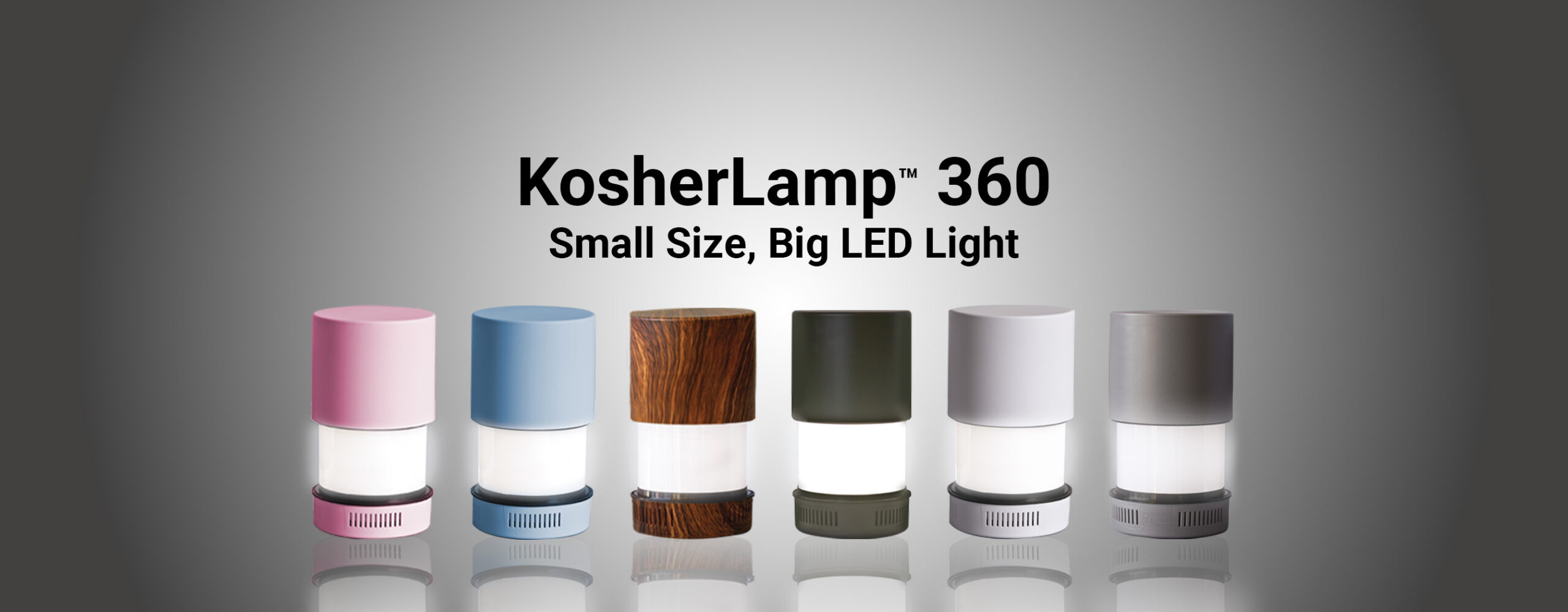
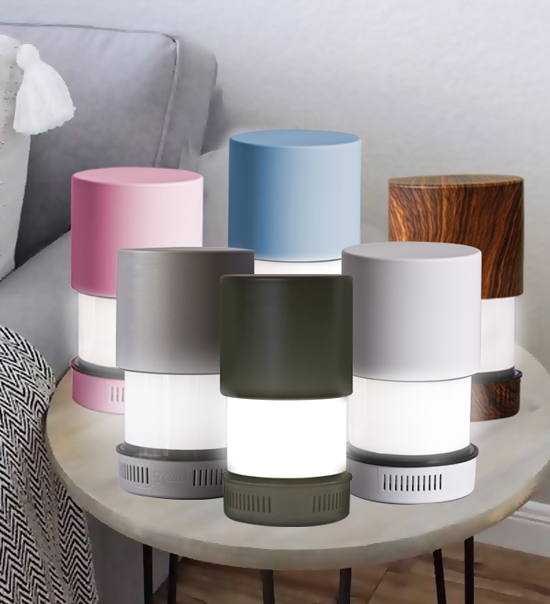
Which brings us to KosherLampTM. Invented and produced by a rabbi-and-businessman duo in Toronto, KosherLampTM resembles any regular table lamp -- but with one key difference: It is constructed of two independent cylinders, one inserted into the other. Each cylinder has its own "window"; when the inner cylinder is twisted, the "windows" are aligned and light comes out. When they are not aligned, the light is completely blocked. With KosherLampTM, the bulb stays burning throughout the duration of Shabbat, enabling a person -- with a simple twist of the shade -- to freely turn the light "on and off." No timers, no switches. "We see this as a small revolution in the observance of Shabbat," says Rabbi Shmuel Veffer, Associate Rabbi of the Aish Village Shul in Toronto and inventor of KosherLampTM. "It's one of those things that after using the lamp, you wonder how you ever got along without it." Breaking the Rules? But, you may ask, isn't this all a bit of cheating? Isn't KosherLampTM -- or even setting a timer -- just a loophole to get around the prohibition of using electricity? Veffer explains: "The only reason why someone would think this is 'cheating' is based on a misperception that Shabbat is all about suffering and denial. Actually, God wants us to enjoy life, so he gave us certain guidelines, to ensure that we 'spend one day with the family and don't run off in a million directions.' Resting on Shabbos is not about "restrictions"; it's about bringing one to a higher recognition of God."
Veffer explains that it's like a basketball star whose greatness is defined by what he can do within the rules. And it is within that structure that the player finds his greatest personal expression. To extend the metaphor, nobody claims that a slam dunk is cheating on the grounds that basketball was meant to be a game of shooting. So what are the "rules" of Shabbat? During the six days of the week, we work to improve the world, mirroring God's six days of creation. But in order to remember that we're not God -- i.e. that the world has a Creator and Sustainer -- on Shabbat, we refrain from acts of creative activity. These are defined by the Talmud as the 39 actions used to build the Tabernacle in the desert. (See: "Laws of Shabbat for Beginners") "KosherLampTM is very much in the spirit of Shabbat," says Veffer. "Every time I twist the KosherLampTM shade, it's a way to think about God in a way that I wouldn't during the week when flicking the switch on and off." Okay, so if it is permitted to use such methods, what's to stop a person from programming a computer to perform a whole series of Shabbat activities -- like automatically turning on the TV Saturday afternoon to watch a football game? The litmus test: Is this in the spirit of Shabbat? It's clearly not in the spirit of Shabbat to gather around the TV and watch a football game. In our case, however, additional light actually enhances the spirit of Shabbat, as the Talmud says, "in bringing more peace into the home." Design Hurdles The spark for Veffer's invention came from something he had seen nearly two decades earlier when his wife gave birth at Shaarey Zedek hospital in Jerusalem. Shaarey Zedek is officially a "Shabbat-observant" hospital, where "light-boxes" are installed over the patients' beds. On Shabbat, the light source can be covered by sliding a metal plate, thus darkening the room without turning off the light. "For many years," says Veffer, "my wife had been asking me to find something similar so she could read on Shabbat with adequate light." So one Sunday afternoon, Veffer and his son visited their local Home Depot store, where they picked up an eclectic assorTMent of raw materials. They started with a simple lamp base, and then attached a louver -- similar to the one that controls the air conditioning in your car -- which served to let the light in and out. They then rigged it all together with styrofoam, electrical tape and... voila!
A few days later, Veffer mentioned his idea to Moshe (Lou) Orzech, a member of his congregation with 10 years of experience designing and producing lamps. "I saw the prototype lamp and was amazed at its simple brilliance," says Orzech. "It's one of those ideas that when you hear it, you say, 'Now why didn't I think of that?!'" The two shook hands and a company was born -- to produce and market KosherLampTM. "Typically, if a rabbi would come up with an idea like this in his garage, he would never be able to carry it through to reality," says Orzech. "There are complex issues of patents, design, engineering, materials, production, import licensing, etc. But in this case, I could provide all that expertise. It was a match made in heaven."
Veffer's prototype was, by his own admission, "clunky, ugly and impractical." But of more immediate concern were two technical hurdles: 1) the lamp wasn't sealed fully (light still escaped when the louver was in the "closed" position), and 2) the lamp was not venting the heat from the bulb, thus presenting a potential fire hazard. They solved the first issue by designing the special "cylinder-with-a-cylinder" system. And for ventilation, they developed a type of zig-zag tunnel inside the lamp, taking advantage of a law of physics whereby heat and air can travel around corners, while light cannot. Further, KosherLampTM was designed to use compact fluorescent light bulbs, which generate less watts, and hence less heat. So instead of a traditional 40-watt incandescent bulb, KosherLampTM uses a 10-watt fluorescent bulb -- producing the same amount of light, with only one-quarter the heat. And at an average energy cost of 10 cents per kilowatt-hour, KosherLamp uses about two cents worth of electricity throughout the duration of Shabbat. Assembly Line The final hurdle -- gaining rabbinic approval for the lamp -- turned out to be easy. Jewish law states:
A shade which is made to direct the light or to cover it up altogether may be adjusted on Shabbat, even if it is made in such a way that it [is all one piece and the shade] forms part of the lamp. (Rabbi Yehoshua Y. Neuwirth - Shemirat Shabbat Kehilchatha 13:41b) Actually, with KosherLamp the question doesn't even get started, since the shade and the lamp are two separate pieces. Indeed, KosherLamp was inspected and approved by top rabbinic scholars including Rabbi Yosef Sholom Eliashiv of Jerusalem, Rabbi Shlomo Miller of Toronto, and Rabbi Dovid Cohen of New York. In May 2004, KosherLamp began rolling off the assembly line in China, and is now available in Jewish bookstores and online at www.kosherlamp.com ($29.95 US, bulb included). Inquiries have come to the website from people in 42 countries -- from Kuwait to Finland to Australia. And what's the reaction of Veffer's wife, Chana, the inspiration behind this small revolution? She says with a smile: "Shabbat has always been perfect. But now it's even better."
May 13, 2004 Kosherlamp changes Shabbat
By CYNTHIA GASNER A revolutionary invention now enables observant Jews to dim a light, or turn it on or off on the Sabbath or yom tov. The halachically approved Kosher-Lamp invented by Rabbi Shmuel Veffer, gives off light or shuts off the light when you rotate an inner shade. Rabbi Veffer of Aish HaTorah Village Shul, says the idea for the lamp originated when his wife Chana, who is an avid reader, asked if he could improvise a light so she could read in the bedroom on the Sabbath. "After a visit to the local hardware store with my son," he says, "we came home with some hodgepodge parts, and by the end of the day we had put together the first clunky working model. By the following Sabbath, our children and friends wanted one." Soon after, the rabbi approached Moshe Orzech, one of his congregants who is in the lighting importing business, and with a handshake, a partnership was formed to produce and distribute the KosherLamp. "After seeing the working model," says Orzech, "I immediately understood the potential. A lamp you can turn on and off on Shabbat - the possibilities were endless." Orzech set off for China to build a prototype, and Rabbi Veffer continued to refine the KosherLamp design. The rabbi, who has a degree from the University of Waterloo in mathematics and computer sciences, designed a website. As well, he approached a number of rabbis in Canada, the United States and Israel and received halachic approval, and then registered the concept with the patent office. He says that the lamp has many uses, not only for observant Jews but for anyone who wants to read but does not want to disturb another person in the room. The design is simple but ingenious, he says. There are two independent cylinders, each with its own window. The inner cylinder can be rotated with a simple twist. When the two windows are aligned, the light comes out. When they are not aligned, the light is blocked and stays inside the lamp. You can adjust the cylinder to allow partial light. Rabbi Veffer says that halachically, you can open and close a cupboard that has a light on inside on the Sabbath. That principal applies with the KosherLamp. When you open the inner shade, the light remains on and when it is closed, the light is not visible. The cost of the KosherLamp is $39.95 in Canada and includes the bulb. The lamp can be shipped anywhere in North America. For more information on the KosherLamp or to order, call 416-487-5483 or 1-866-661-5483, or online www.kosherlamp.com
SJ Super 7 The seven most amazing things you will discover in Jewish life and culture. This week: Ben Stiller takes on Starsky, Malcolm Rifkind makes his political comeback, welcome to the Kosherlamp and Hebrew National enter the Mezuzah market. 29/02/2004 SJ Super 7 by: Leslie Bunder and Caroline Westbrook Let there be light: a new invention in the US is set to end the problem of not being able to turn the lights on and off on Shabbat. Kosherlamp consists of a pair of cylinders with a fluorescent lamp inside, which is revealed when the outer cylinder is twisted. The device has already received full rabbinic approval and, according to its website, means you can "finally read in bed on Shabbat." Find out more at: www.kosherlamp.com
JTO Monthly (November/December 2007) "Last Chanukah, I received a most wonderful gift..."
|
|
|||||||||||||||||||||||||||||||||||||||||||||||
|
|
|||||||||||||||||||||||||||||||||||||||||||||||||
|
|
|||||||||||||||||||||||||||||||||||||||||||||||||
|
|
|||||||||||||||||||||||||||||||||||||||||||||||||
|
|
|
||||||||||||||||||||||||||||||||||||||||||||||||
|
|
|
||||||||||||||||||||||||||||||||||||||||||||||||
|
|
|||||||||||||||||||||||||||||||||||||||||||||||||
|
|
||||||||||||||||||||||||||||||||||||||||||||||||
|
|
|||||||||||||||||||||||||||||||||||||||||||||||||
|
|
||||||||||||||||||||||||||||||||||||||||||||||||
|
|
|
|
|
|
|
|
|
|
|
|
|
|
|
|
|
|
|
|
|
|
|
|
|
|
|
|
|
|
|
||||||||||||||||||||